
The week of the General Assembly generates more announcements than any person can absorb. Pledges, coalitions, task forces, frameworks, institutes. Some of them will matter. Most will not. Nobody in the room can reliably tell you which is which, including the people making the announcements, and I have stopped pretending I can either.
Climate Week opened this year on a Sunday night at THE NAT, a gala built around closing the nature finance gap, themed Water is Life, in a room of world leaders and philanthropists and investors. Climate investor and former refugee Tenzin Seldon took the stage, introduced by Emma Watson, and laid out an idea called Gross Domestic Regeneration: the number an economy should run on in place of GDP, one that counts what we protect and restore (Pulse Fund 2026).
By Wednesday evening I was sitting with the advisory council of Columbia University’s Sustainable Investing Research Initiative (SIRI), which I recently joined and about which I should disclose I am not remotely neutral. SIRI is attempting something immodest, which is to rebuild the intellectual foundations underneath how money moves. That evening gave me more hope than I expected to feel. The premise is that we might yet leave our children and grandchildren an economy organized around what we restore and repair rather than what we strip out and sell.
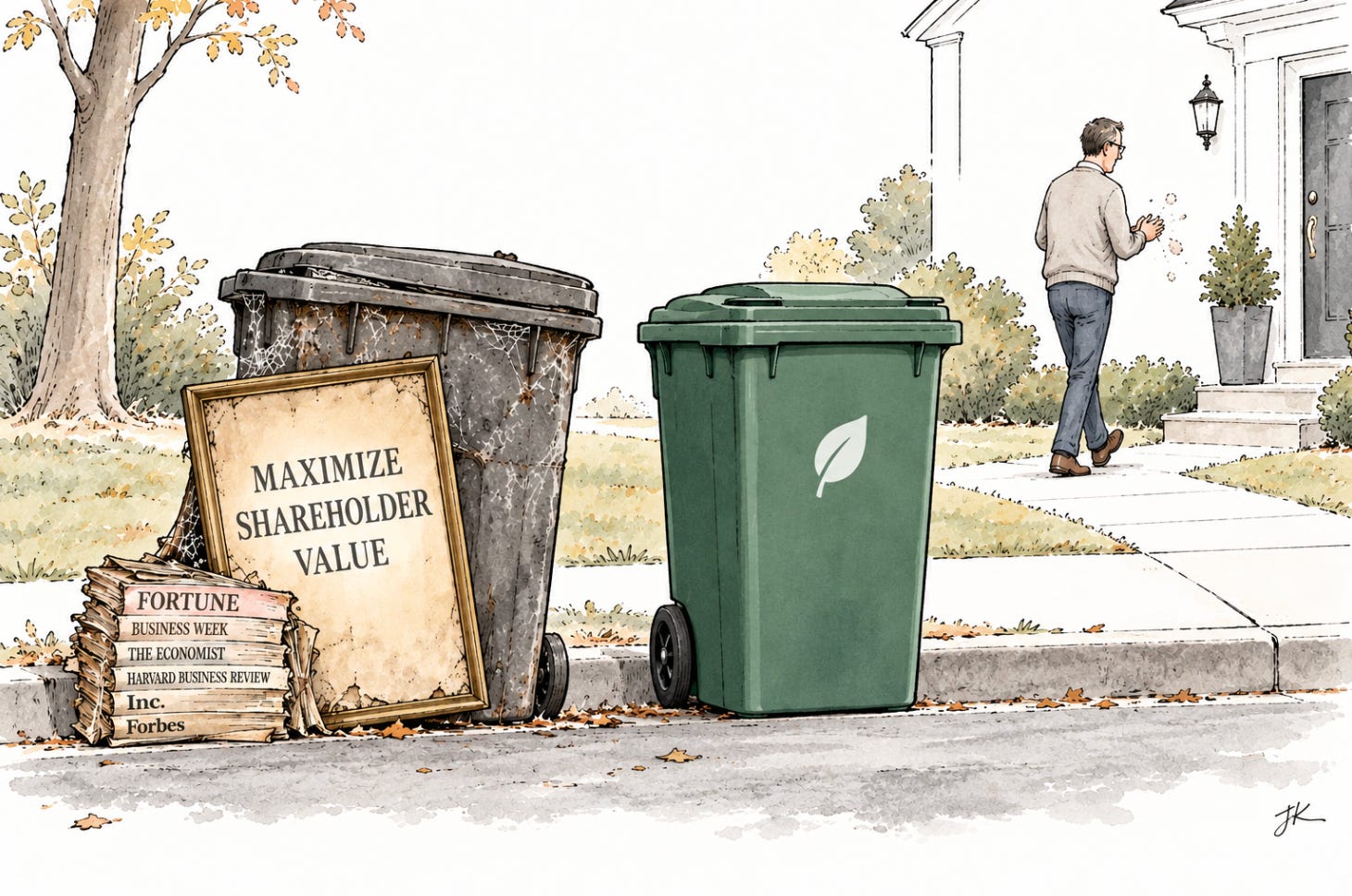
That is not the economy we inherited. The one we have was taught to us. The Chicago School of Economics supplied the architecture, and Milton Friedman in particular supplied the permission slip, arguing in 1970 that the social responsibility of business is to increase its profits and that anything else amounted to a manager spending someone else’s money (Friedman 1970). It was an elegant argument that has been enormously influential, and it has been, I think, catastrophic. It established a frame in which the damage a company does to the systems it depends on is genuinely somebody else’s problem, and it did so at precisely the moment when the scale of that damage began to compound. Extraction is not a feature of human nature. It is a habit we built an intellectual case for over the last several decades that has origins in the fracture of ethics from economics.
So I spent the rest of this week turning Seldon’s idea over. Not because I think it is wrong, as I think her instincts behind it are spot on, but because the question of what would actually have to happen for an idea like this to take root turns out to be far more interesting than the question of whether it is a good idea.
The proposal
Seldon runs Pulse Fund, which invests in climate companies across energy, food and agriculture, infrastructure and mobility. The idea comes out of something she saw as a child in the Himalayas, where glacial meltwater took the field she played in. Her argument then starts where almost every argument in this space starts, with Simon Kuznets.
Kuznets built the first national income accounts and presented them to Congress in 1934 as an emergency measurement tool for the Depression. He told lawmakers explicitly that the welfare of a nation could scarcely be inferred from a measurement of national income. We adopted the measure anyway, made it the global standard, and have spent ninety years treating a Depression-era output gauge as a scorecard for human prosperity. Big oops.
Her illustration is Brazil, where, by her account, GDP climbed roughly twenty percent over five years while deforestation climbed at about double that rate (Seldon 2026a). On that scoreboard, burning a forest counts as growth. She makes the same point about disaster reconstruction, about pollution driving healthcare spending, about extraction generally. GDP registers the transaction and says nothing about whether the transaction strengthened or consumed the thing that produced it. Thus have we arrived at all of the fallout from modern economics: widening wealth inequalities, a burning planet, rising forced displacement, and unmitigated synthetic intelligence that is quite possibly less than 18 months away from escaping our control.
Her alternative asks what was restored rather than what was produced. Did the soil improve. Did the water systems replenish. Did communities get stronger. Did this year’s prosperity increase or reduce the capacity of next year’s.
She tells it through two farmers, which is a good parable. One strips the soil and takes everything the land will give, posting strong yields until the organic matter is gone and the water stops holding and the land fails. The other builds the soil season by season, and a hundred years on the farm is worth more than it is today. The difference between them is not simply ethics. It is accounting. One is measuring output and the other is measuring capacity.
I find this compelling. I spend a fair amount of my time on questions about how land and nature get valued, and the observation that our accounting cannot distinguish between building something and consuming it is not abstract to me. It shows up every time someone tries to finance ecological improvement and discovers that no lender recognizes it, no appraiser prices it, and no insurer discounts for it.
So the instinct is right. What happens next is the hard part.
The case has already been made
Here is the thing that surprised me when I started reading, and that I suspect will surprise most people who follow this conversation casually, if at all.
The case against GDP as a measure of progress has been made, repeatedly, by the most credentialed people available, and it has been formally accepted at the highest level of international governance. What has not followed is any change in how the world actually keeps score.
In 2009, at the request of Nicolas Sarkozy, Joseph Stiglitz, Amartya Sen and Jean-Paul Fitoussi produced a commission report on the measurement of economic performance and social progress that remains the most authoritative critique of GDP anyone has written (Stiglitz, Sen and Fitoussi 2009). Two Nobel laureates and a distinguished economist, commissioned by a head of state, concluding that the measure was inadequate. That was seventeen years ago! GDP is still the scoreboard.
In March 2021 the UN Statistical Commission adopted the System of Environmental-Economic Accounting Ecosystem Accounting as an international statistical standard, after years of testing, consultation and revision (UN SEEA 2021). This is the part almost nobody talks about. SEEA is a rigorous, internationally agreed framework for measuring the extent and condition of ecosystems, quantifying the services they provide, and linking that to economic activity. Ecosystem accounts have since informed policy in more than thirty-four countries, including Australia, Brazil, Canada, China, Mexico, the Netherlands, Norway, the Philippines, South Africa, Uganda, the United Kingdom and yes, even the United States (Obst and Alfieri 2021).
A standard for accounting for nature exists. Countries are using it. And yet, GDP still runs everything.
The same year, Partha Dasgupta delivered his review of the economics of biodiversity, commissioned not by an environment ministry but by HM Treasury (Dasgupta 2021). The Secretary-General named overreliance on GDP as a problem requiring correction in Our Common Agenda. In 2024, in the Pact for the Future, member states committed to developing measures that complement GDP, which gave the agenda a universal political mandate rather than just technical support.
And then, on 7 May of this year, the Secretary-General’s independent High-Level Expert Group on Beyond GDP released what the UN described as the first global blueprint for how countries can assess progress alongside GDP, built around a ready-to-use dashboard of globally applicable indicators (United Nations 2026). An intergovernmental process is now getting underway off the back of it (UNU-CPR 2026).
That was four months before Climate Week, and I would guess most people reading this had not heard about it (I had not).
I am not raising this to diminish anyone. I am raising it because it changes the question. If the problem were that nobody had noticed GDP was inadequate, or that nobody had built an alternative, then the useful contribution would be noticing and building. But people noticed decades ago and have built many alternatives. Bhutan has run Gross National Happiness for years. The Genuine Progress Indicator exists and gets used in a handful of American states. The Inclusive Wealth Index, out of UNEP and the Arrow and Dasgupta tradition, measures produced, natural and human capital as stocks rather than flows, which is very close to what a regeneration measure would have to do.
None of them displaced GDP. So the real question isn’t really what a better measure would look like. It is why better measures keep failing to take hold, and what would have to be different this time.
Four things that seem to matter
I am not an economist so I want to be mindful about the limits of what I can claim. But reading through the history of these attempts, four patterns show up often enough to call them out.
The first is that somebody has to be required to produce the number. SEEA moved partly because SDG indicator 15.9.1 asks countries to report on integrating biodiversity values into national accounting. That obligation created demand for a methodology, and the methodology got built and adopted because statistical offices needed something to report against. A measure that answers no mandatory question depends entirely on voluntary enthusiasm, and enthusiasm does not distribute anything, particularly when competing against short-term self-interest which is an entrenched quality of modern extractive capitalism. It is worth asking of any new metric what obligation would ever require someone to compute it.
The second is that it has to end up in law rather than in a brand. New Zealand illustrates this better than I can argue it, so I’ll dig into this in a moment.
The third is being clear about what kind of thing is actually being counted. GDP counts activity: what got bought, built and sold over the course of a year. Regeneration is about condition: how deep the topsoil is, how full the aquifer, how much forest is still standing. Economists call the first a flow and the second a stock. In plainer terms, one is an income statement and the other is a balance sheet, and you cannot add them together into a single figure. Seldon’s two farmers make the point. For years their income statements look much the same. Their balance sheets do not. So any new measure has to say which of the two it is producing. The Inclusive Wealth Index chose the balance sheet and became rigorous and much harder to explain, which is the trade you make, and most proposals avoid making the choice at all.
The fourth is that it has to pick between a single number and a dashboard but swallow the cost either way. One number communicates and cannot be fully defended, because weighing soil carbon against human wellbeing requires weights, and weights are political choices wearing the clothes of arithmetic. A dashboard is defensible but gets ignored, because practically speaking, who can hold twenty indicators in their head? Notably, the UN Expert Group went with a dashboard, and the expert workshops that followed still treated the development of headline indices as critically important (UNU-CPR 2026). To me, this suggests the people closest to this know a dashboard alone is not sufficient and have not solved the problem either.
Geoffrey Holland, in a thoughtful piece on Seldon published a few days after the gala, gets to the edge of that last one when he asks how soil restoration should be compared with improved public health (Holland 2026). It is exactly the right question. It is also the question that has broken most of this field for fifty years, and I do not think anyone has answered it.
New Zealand
If you want to understand what survives and what does not, New Zealand is the clearest case I have found.
The Treasury began developing its Living Standards Framework in 2011 as an analytical tool, released a dashboard of wellbeing indicators in December 2018, and delivered a Wellbeing Budget in 2019 that used the framework to set spending priorities (OECD 2023). In 2020 an amendment to the Public Finance Act required the government to report annually on its wellbeing objectives alongside its fiscal objectives, and required the Treasury to report on the state of wellbeing in New Zealand every four years. The first of those reports came in 2022.
Then the government changed. By March 2024 the press was writing the Wellbeing Budget’s obituary (Walters 2024).
Except that the statutory reporting requirement is still in force. The Living Standards Framework is still there. The dashboard was still being updated in December 2025, carrying data through that October (New Zealand Treasury 2025).
The brand died but the plumbing lived. The plumbing lived because it had been written into the Public Finance Act, and the brand died because it had been written into a press release. Big difference!
I keep returning to this. It suggests that the durable version of this work is unglamorous, legislative and largely invisible, and that the visible version is the part most likely to evaporate when the political weather changes. It also suggests something about where effort is best spent, which is not in the launch.
The questions I would want answered
Gross Domestic Regeneration is at the stage where it is a compelling frame rather than a defined method. Holland says as much in his piece, and to his credit he does not pretend otherwise. There is no published methodology I can find, no data pipeline, no aggregation rule, no unit of account. That is where most ideas are when they launch and it is not a criticism.
But it does mean the interesting conversation is about what comes next, and there are a handful of questions I would like to hear answered. I am posing them as questions because I really do not know the answers, and because the answers would tell you a great deal about whether this becomes infrastructure or becomes just another good idea.
Is it a national measure or a company measure? At THE NAT it was described as the number an economy should run on in place of GDP, which is unambiguously a claim about national accounting. In her Forbes piece from June, Tenzin describes GDR as a frame she uses when evaluating companies (Seldon 2026b). Those are different instruments with different data requirements, different users and different paths to adoption. A firm-level frame competes with integrated reporting and impact measurement, but it’s something any investor could theoretically adopt on their own at their own speed. A national measure competes with the System of National Accounts. Knowing which it means to be would clarify almost everything else.
And is the ambition to replace GDP or to sit alongside it? This sounds like a technicality but it’s not. The entire UN effort, from the Pact for the Future through the May blueprint, is framed around measures that complement GDP. Replacement is a larger claim with much longer odds, because it means persuading every finance ministry and central bank and ratings agency to run on something new. Speaking frankly, I’m in favor of the bigger vision, despite the higher hurdle. Complementing is how SEEA got adopted. Both are legitimate ambitions but they imply completely different strategies, and the language at the gala pointed one way while most of the institutional machinery points the other.
Where does it sit relative to SEEA? If a country is already compiling ecosystem accounts under an internationally adopted standard, what does this ask them to do differently, and why would a statistical office take that on?
How does it relate to the intergovernmental process already underway? A private institute developing a parallel framework could be enormously useful as a source of methodology and pressure, or it could be duplicative. The difference probably comes down to whether it is designed to plug in or to compete.
Stocks or flows, and index or dashboard? Both forks should be resolved but neither has an answer without some cost.
And what would ever compel anyone to calculate it? This is really the one I would ask first. Not because the answer has to exist yet, but because working backward from it tends to reshape everything else about how you build.
What I am watching for
There is one more reason this matters that has nothing to do with accounting theory, and it is the argument I wish more people made.
GDP-centric rules govern who gets access to concessional finance. Countries are classified, graduated and priced on the basis of income measures that say nothing about the condition of what they are sitting on or what they are drawing down. The Sevilla Commitment made that explicit (IISD 2026). This is not a debate about statistics. It is a debate about which countries can afford to borrow, and on what terms, and therefore about who gets to build anything at all. If a better measure changed nothing else, changing that would be meaningful.
So I am sympathetic. I want this to work, or something like it to work, and I am glad someone with capital markets credibility is pushing on it rather than standing outside throwing rocks.
What I will be watching for over the next year is not whether the idea attracts attention. It already has, and there will be more profiles, and the profiles will be admiring. A gala that opens Climate Week is a room worth having, and nature finance needs the money and the visibility that rooms like that generate. But attention was never what this particular problem was short of. Stiglitz and Sen had attention.
I will be watching for a published methodology with its choices made explicit. For a relationship to the UN process, whether that turns out to be collaboration or an argument. For some account of what obligation would make a statistical office or a finance ministry actually produce the number. For a decision about whether this measures companies or countries, and whether it replaces GDP or complements it. And for the work to be given away rather than held, because the standards that spread are the ones anybody can pick up without asking permission, which is how SEEA travelled, and GAAP, and IFRS, and the TCFD recommendations.
None of that is glamorous. All of it is the part that determines whether anything happens.
I have no relationship with Tenzin Seldon and no stake here beyond wanting the problem solved by someone. I would rather ask these questions in public, where she and other smarter people than me can work on answers together. The idea deserves that much. Taking something seriously enough to test it is a better form of respect than admiring it, and the history here suggests the frameworks that survive are the ones that get argued with early.
Friedman’s frame took about a decade to move from a newspaper essay to the operating assumption of American business. It is worth remembering that it did not win because it was true. It won because it was clear, because it was taught, and because it was eventually written into the machinery of how companies are governed and how performance is judged. Whatever replaces it will have to be built the same way, by people willing to do the boring parts, and probably over a longer horizon than any of us would like. So we might as well get cracking.
Sources
Dasgupta, Partha. 2021. The Economics of Biodiversity: The Dasgupta Review. London: HM Treasury.
Friedman, Milton. 1970. “The Social Responsibility of Business Is to Increase Its Profits.” The New York Times Magazine, 13 September.
Holland, Geoffrey. 2026. “Tenzin Seldon: Measuring What We Restore.” Geoffrey Holland Partnership, September.

IISD. 2026. “Beyond GDP: Where We Stand, What We’ve Learned, and What Comes Next.” SDG Knowledge Hub, 28 April. https://sdg.iisd.org/commentary/policy-briefs/beyond-gdp-where-we-stand-what-weve-learned-and-what-comes-next/
New Zealand Treasury. 2025. “Measuring Wellbeing: the LSF Dashboard.” December. https://www.treasury.govt.nz/information-and-services/nz-economy/higher-living-standards/measuring-wellbeing-lsf-dashboard
Obst, Carl, and Alessandra Alfieri. 2021. “Beyond GDP: United Nations Adopts New SEEA Ecosystem Accounting Standard.” Capitals Coalition. https://capitalscoalition.org/beyond-gdp-united-nations-adopts-new-seea-ecosystem-accounting-standard-by-carl-obst-alessandra-alfieri/
OECD. 2023. “New Zealand’s Living Standards Framework and He Ara Waiora Framework.” Well-being Knowledge Exchange Platform. https://www.oecd.org/en/publications/well-being-knowledge-exchange-platform-kep_93d45d63-en.html
Pulse Fund. 2026. “Tenzin Seldon at THE NAT.” LinkedIn, 22 September.
Seldon, Tenzin. 2026a. “Seldon: New Systems Needed to Fight Climate Change.” Aspen Daily News, 22 April. https://www.aspendailynews.com/opinion/article_f8cda197-ea0f-4d4e-9664-8cd60d2efb51-23e93737
Seldon, Tenzin. 2026b. “The Metric Problem: Why Smart Capital Is Looking Beyond GDP.” Forbes Finance Council, 25 June. https://www.forbes.com/councils/forbesfinancecouncil/2026/06/25/the-metric-problem-why-smart-capital-is-looking-beyond-gdp/
Stiglitz, Joseph, Amartya Sen, and Jean-Paul Fitoussi. 2009. Report by the Commission on the Measurement of Economic Performance and Social Progress. Paris.
THE NAT. 2026. “A Global Movement for Nature.”
https://www.thenat.com/
United Nations. 2026. “United Nations Proposes New Global Dashboard to Measure Progress Beyond GDP.” UN DESA, 7 May. https://www.un.org/en/desa/united-nations-proposes-new-global-dashboard-to-measure-progress-beyond-gdp
UN SEEA. 2021. “Ecosystem Accounting.” United Nations System of Environmental-Economic Accounting. https://seea.un.org/en/methodology/ecosystem-accounting
UNU-CPR. 2026. “Towards a New Compass of Progress: The Start of the UN Intergovernmental Process to Move Beyond GDP.” United Nations University Centre for Policy Research, 14 May. https://unu.edu/cpr/blog-post/towards-new-compass-progress-start-un-intergovernmental-process-move-beyond-gdp
Walters, Laura. 2024. “The Wellbeing Budget Is Dead.” Newsroom, 22 March. https://newsroom.co.nz/2024/03/22/the-wellbeing-budget-is-dead/
Thanks for this insightful piece John. It’s helped me in my assessment of GDR for my own Substack. It’s got challenges, but the aggregation into a single number is a signifiant step forward.